The toy aisle is full of boxes stamped with the word “STEM.” Robots, coloring kits, puzzle sets, wooden blocks — if it has a battery or a gear, there’s a good chance someone slapped an educational label on it. For parents trying to spend money wisely, it can feel impossible to tell the difference between a toy that genuinely builds skills and one that will sit forgotten on a shelf after twenty minutes.
The frustrating truth is that not every STEM-labeled toy actually teaches science, technology, engineering, or math. Many are designed to look educational without offering real developmental value. Knowing what to look for before you buy can save you a lot of money and a lot of disappointment.
This guide breaks down exactly what child development research says makes a STEM toy worth your child’s time, and what red flags to watch for at every age from preschool through middle school.
What a Real STEM Toy Actually Does
A genuine STEM toy does more than entertain. According to the Toy Association, the two non-negotiable qualities of any legitimate STEM toy are that it must promote an aspect of science, technology, engineering, or math, and it must be genuinely fun. If either quality is missing, it falls short on both counts.
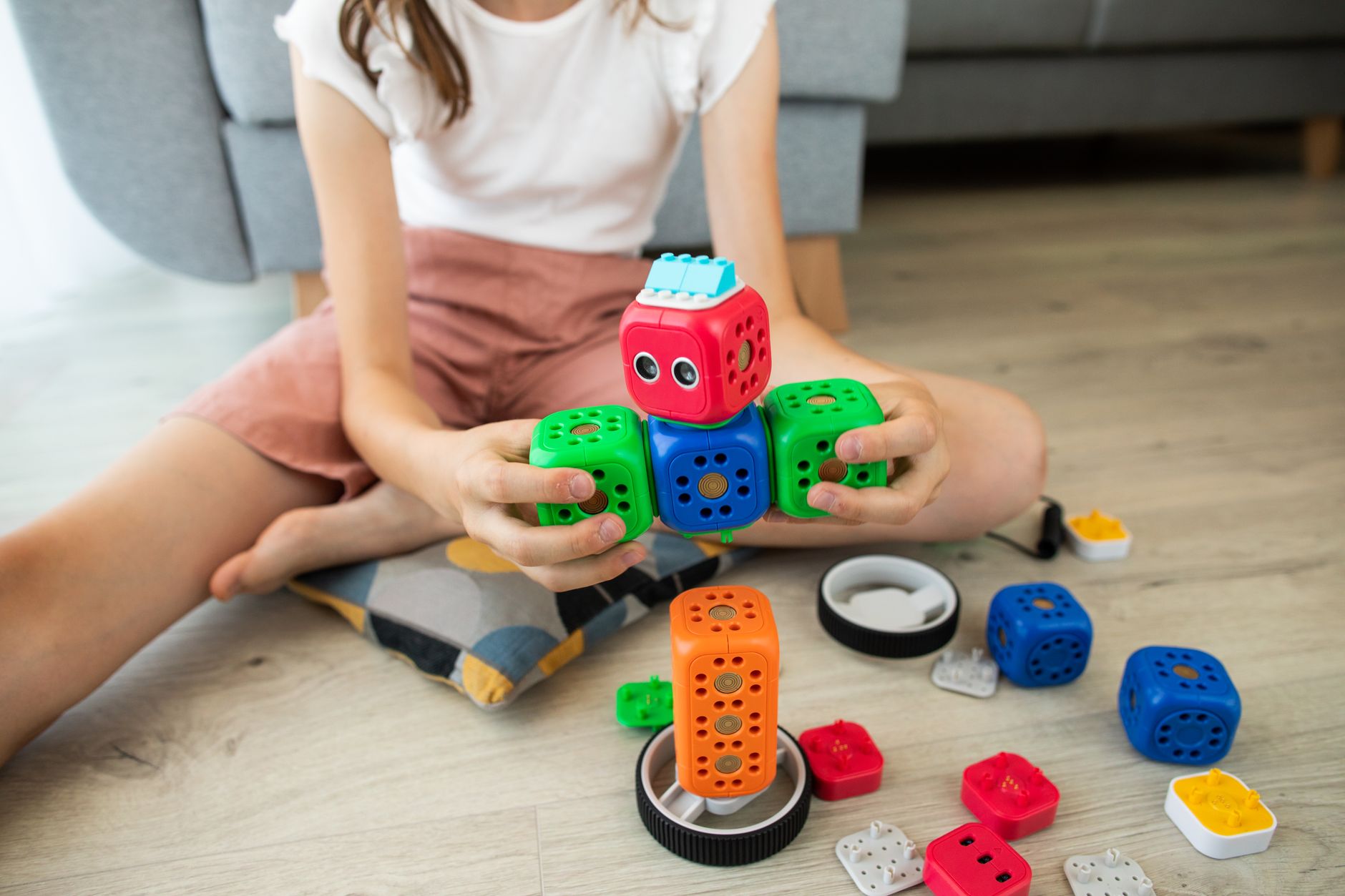
What that looks like in practice: the toy should require your child to think, plan, or experiment rather than just watch something happen. A toy that your child assembles and then programs to move is a real STEM toy. A toy that walks and lights up on its own with no child input is a gimmick. The distinction matters because meaningful learning happens through active engagement, not passive observation.
Experts at Barnard College’s Center for Toddler Development note that young children are naturally wired to figure things out, and any toy that gives them the opportunity to solve a puzzle, build a structure, or test a hypothesis taps directly into that drive. The key word is opportunity — the child has to be the one doing the work.
The Four Questions to Ask Before You Buy
Before adding anything to your cart, run it through these four questions:
- Does it require child input? Good STEM toys demand building, planning, adjusting, and problem-solving. If the toy does everything automatically, your child is an audience, not a learner.
- Is it open-ended? The best STEM toys let a child create different outcomes every time — building sets, science kits, and coding tools fall into this category. Gimmick toys typically offer only one fixed result, which makes them exciting for a few minutes before becoming shelf decoration.
- Does it match your child’s developmental stage? A toy that is too advanced will frustrate your child, while one that is too simple will bore them. Developmental fit is not optional — it determines whether any learning actually happens.
- Will it grow with your child? Look for modular or expandable toys that unlock deeper challenges as your child’s abilities improve. A toy that supports multiple levels of play stretches your investment and keeps kids engaged over years, not weeks.
If the answer to most of these is no, leave it on the shelf.
Age-by-Age Guide to What Actually Fits
STEM learning looks very different across childhood, and the right toy at the wrong age teaches nothing.
Ages 3–5 (Preschool): Focus on sensory exploration, cause and effect, and simple construction. Large building blocks, shape sorters, and basic puzzle sets are ideal. Research shows that even simple number-based board games at this age can significantly improve counting and number recognition skills — a University of Oregon meta-analysis found a 76 percent chance that children playing linear number games will improve their core numeracy skills after just a few short sessions.
Ages 6–8 (Early Elementary): Children at this age are ready for magnetic tiles, beginner robotics, and hands-on experiment kits. They can follow multi-step instructions and handle the mild frustration of trial and error, which is exactly the mindset good STEM play is designed to build.
Ages 9–12 (Upper Elementary/Tween): This is when coding tools, electronics kits, and more complex construction sets become genuinely engaging rather than overwhelming. Tweens can handle abstract concepts like sequencing and basic engineering logic, and they benefit most from toys that connect playtime to real-world problems they can recognize.
For board-game-style STEM learning that fits younger kids especially well, see our roundup of best board games for kids under 10.
The Sneaky Gimmick Warning Signs
Once you know what good looks like, the red flags become easier to spot:
- The “STEM” label is the entire pitch. If the packaging leads with the acronym rather than explaining what the child actually does, be skeptical. A genuine educational toy can describe its learning value in plain terms.
- It does everything for the child. Lights, sounds, and automatic movement are not inherently bad, but if they are the entire experience, there is no learning pathway. The child should be the one driving outcomes.
- It gets boring fast. Gimmick toys are engineered for a dramatic first impression, not sustained engagement. If reviewers consistently mention that kids lose interest within an hour, that is meaningful data.
- It has no real-world connection. The Toy Association’s research found that strong STEM toys help children and parents understand how the play experience connects to actual science or engineering. A toy that exists in its own closed loop, with no link to anything a child might encounter in the real world, misses a key ingredient.
- It breaks or loses pieces immediately. Poor build quality ruins both learning and confidence. A toy that falls apart after a week is not just a waste of money — it sends kids the wrong message about persistence.
How Board Games and Digital Tools Fit Into STEM Play
Parents sometimes overlook two categories that carry serious STEM value: board games and screen-based tools.
On the board game side, a peer-reviewed study published in the journal Early Years found that number-based board games improved math skills in children aged three to nine in more than half of the tasks analyzed, outperforming control groups in nearly a third of cases. Researchers noted that these games are easy to use, affordable, and can be adapted to target specific skills. For older kids ready for strategy-level thinking, our guide to best board games for ages 10 and up covers options that build the kind of logical reasoning that supports STEM learning in school.
On the digital side, tablets used with age-appropriate coding and building apps can be a legitimate STEM tool, especially for kids ages 9 and up who are ready to work in tools like Scratch or Tynker. The key, as with physical toys, is whether the child is actively creating or passively consuming. If you are thinking through the right device to support that kind of use, our breakdown of best kids tablets for road trips includes options with solid parental controls and educational app ecosystems, and our guide to best tablets for teens covers the older end of the range.
Related Guides
- best board games for kids under 10
- best board games for ages 10 and up
- best kids tablets for road trips
- best tablets for teens
Frequently Asked Questions
Do STEM toys actually make kids smarter?
Research supports that hands-on STEM play builds specific skills like spatial reasoning, problem-solving, and early math ability rather than broadly raising intelligence. A University of Oregon meta-analysis found that just a few ten-minute sessions with number-based board games can produce measurable improvements in counting and number recognition in children as young as three. The benefit depends heavily on whether the toy genuinely engages the child in active thinking.
At what age should I start buying STEM toys?
Simple STEM play can begin as early as age two or three with large building blocks, shape sorters, and basic cause-and-effect toys. The goal at that age is sensory exploration and early motor development, not formal learning. More structured STEM toys, like beginner robotics or experiment kits, are better suited to ages six and up when children can follow multi-step instructions and handle trial and error without becoming overwhelmed.
Are expensive STEM toys better than cheap ones?
Price is not a reliable indicator of educational quality. Some of the most research-backed STEM tools for young children, like simple linear number board games, cost very little. The qualities that matter are open-ended play, developmental fit, and active child engagement. A basic building set that a child returns to for years delivers more value than a high-priced single-function gadget.
Can board games count as STEM toys?
Yes, and there is solid research to back this up. Number-based board games have been shown to improve counting, addition, and number comparison skills in children ages three to nine, according to a peer-reviewed study in the journal Early Years. Strategy games for older children build logical reasoning and planning skills that directly support STEM learning. Board games also add social and emotional development benefits that most solo STEM toys do not.